Wildlife
The Night Is Not Empty
How artificial light changes a world built for darkness
The night is not empty. We just lit it as if it were.
Moths come to lamps and die against them, or circle until they are spent. Hatchling turtles crawl toward a parking lot instead of a horizon of water. Migratory birds, flying on stars and a magnetic sense we still only partly understand, stall in the glow of towers and glass. These are not metaphors. They are among the better-documented side effects of a technology we installed for ourselves.
Electric light lengthened the day for human work, sport, and a feeling of safety. It also leaked. Unshielded fixtures throw photons where no task exists: into bedrooms, into treetops, into the sky, where they become a dome of glow that erases the Milky Way and, more importantly, erases a cue. Insects that navigate by lunar light, birds that move at night to avoid heat and predators, coral that times spawning by moonlight—these are users of darkness. They were not consulted.
Established: many species evolved with reliable cycles of dark and light, and artificial light at night can disorient migratory birds, hatchling turtles, and insects. Established, too: skyglow alters the night far beyond the fixture that produced it. Probable: chronic lighting shifts the timing of feeding, breeding, and rest in more species than we have yet measured well. Still open: how much any single city’s lighting contributes to a regional insect decline, once pesticides, habitat loss, and climate are in the same frame. The night is a habitat. That statement does not require us to pretend we have finished the accounting.
A lamp is not a moon
The moth at the porch light is the oldest public image of the problem, and it is not a cartoon. Many nocturnal insects use celestial cues to keep a straight course. A distant moon or a star field presents a nearly parallel set of rays; an animal that holds a constant angle to those rays flies a straight line. A nearby lamp presents rays that change angle as the insect approaches. The result, in a large experimental and observational literature, is flight-to-light: circling, stalling, collision, exhaustion, and an easy meal for a predator that has learned the address.
That mechanism is established. What it does at the scale of a moth population is harder. British monitoring has shown substantial declines in many common macro-moths since the 1970s; habitat change and climate are the leading explanations. Light is a plausible additional pressure, and in some settings a demonstrated one. In a multi-year Dutch field experiment, Roy van Grunsven and colleagues found that after the second year, moth numbers were about fourteen percent lower under experimental illumination than in dark controls. A 2021 review by Douglas Boyes and colleagues found strong evidence that artificial light affects moth behaviour and physiology, and little rigorous evidence that those effects yet scale to population change. Avalon Owens and colleagues have argued that light at night is an overlooked driver of insect declines more broadly; Boyes’s group cautioned that some of that claim was premature. Established: attraction, wasted flight, disrupted feeding and reproduction in many insects. Probable: a contribution to local declines where light is chronic. Unknown: the share of any continental insect decline that belongs to the lamp rather than to the field, the spray, and the weather.
Spectrum matters for attraction and does not settle the ledger. Mercury vapour and metal halide lamps tend to draw more moths than sodium lamps or many LEDs. Cool-white LEDs, sold as efficiency, are rich in short wavelengths that scatter readily and that many nocturnal animals see well. Warmer spectra generally attract fewer insects at the fixture. They do not restore a dark landscape if the fixtures are still too many, too bright, and unshielded. Intensity and duration remain the first variables. Colour is a refinement, not a pardon.
The crawl that should have been seaward
A hatchling sea turtle, emerging at night on a nesting beach, does not need a map of the ocean. It needs a gradient. On an undeveloped shore the seaward horizon is, on average, brighter and more open than the dune and the vegetation behind it. Hatchlings orient by that relative brightness and by the shape of the skyline. Blair Witherington and colleagues showed, decades ago, that this sea-finding is visual, that it works across lunar phases—so the moon itself is not the compass—and that an artificial source close enough to glare will override the rest of the scene. The turtle crawls toward the lamp, the hotel, the parking lot. Florida’s wildlife agency has long treated the result as a conservation problem measured in thousands of hatchling deaths a year: dehydration, exhaustion, predation, and vehicles, and, even for those that later reach the water, a depleted reserve for the swim offshore.
Misorientation is a crawl in the wrong direction; disorientation is circling without a heading. Both are well documented for loggerheads, greens, and other species on developed coasts. An analysis of Pinellas County, Florida, found disorientation at more than a third of successful emergences over six seasons. Experimental reviews report still higher misorientation under broad-spectrum lamps. That is not a global percentage for all beaches. It is a demonstration that the cue is fragile.
Fully shielded, long-wavelength lamps—narrow-spectrum sources peaking in the orange-red—have, in arena trials on Florida’s west coast, allowed loggerhead hatchlings to keep a seaward heading where an unshielded white source would not. That is not a license to light a nesting beach. Nesting females are affected as well: artificial light can deter them from coming ashore or displace them along the coast. Lighting ordinances exist because the pathway is not in dispute. Enforcement and fixture design remain the unfinished work.
Birds, glass, and a sky that will not stay dark
Most of the songbirds that cross North America in spring and autumn fly at night. They use the stars, the Earth’s magnetic field, and other cues that a photopolluted sky can scramble. They also, in daylight and at dawn, fail to read glass. The two hazards cooperate. Light draws birds into cities and holds them. Glass finishes the collision.
Scott Loss, Tom Will, Sara Loss, and Peter Marra, compiling twenty-three studies, estimated that between 365 and 988 million birds are killed each year by building collisions in the United States, with a median near 600 million. Roughly fifty-six percent of that mortality was attributed to low-rises, forty-four percent to residences one to three stories tall, and less than one percent to high-rises. A single skyscraper can kill more birds than a house. There are vastly more houses. The editorial temptation is to photograph the tower. The arithmetic is more ordinary, and more demanding.
Night lighting changes where that arithmetic happens. In New York, Benjamin Van Doren, Kyle Horton, and colleagues used radar and acoustic sensors at the National September 11 Memorial’s Tribute in Light to show that two vertical xenon beams could concentrate migrants even in a city already bright, and even in good visibility, to altitudes of four kilometres. Across seven commemorative nights over seven years they estimated that the beams influenced on the order of 1.1 million birds. Densities near the installation exceeded surrounding baseline by a factor of twenty in the observations they modelled. Birds slowed, circled, and called. When the lights were extinguished for twenty minutes, the aggregation dispersed. The finding is not an argument against a memorial. It is a measurement of how quickly behaviour follows a switch.
Chicago’s McCormick Place, monitored for decades by Field Museum scientists at dawn, offered a longer ledger. Van Doren and colleagues found that nights with about half the windows darkened had on the order of eleven times fewer collisions in spring and six times fewer in autumn than nights with the building fully lit, after accounting for weather and migration volume. Cutting lighted window area in half during migration seasons could, they estimated, reduce mortality at that building by about fifty-nine percent. The birds are not lost. They are being addressed.
Communication towers add a third geometry. Joelle Gehring, Paul Kerlinger, and Albert Manville compared fatalities at Michigan towers and found that guyed towers lit with a combination of flashing beacons and steady-burning red lights killed more night-migrating songbirds than towers lit only with flashing lights, red or white. Removing the steady-burning lamps was associated with a reduction on the order of fifty to seventy-one percent. The FAA later allowed that change. Guy wires and height still kill. Light was the part of the system that could be edited without taking the tower down.
Horton, Van Doren, and colleagues have shown that migratory exposure to city light is uneven: Chicago, Houston, and Dallas ranked among the highest. Those cities sit under rivers of birds. Lights Out programs—Audubon’s network now includes dozens of cities—ask building managers to extinguish decorative lighting and dim interiors during peak migration. The intervention is seasonal, cheap, and supported by the Tribute and McCormick Place results. It does not fix residential glass. It does not need to in order to be worth doing.
Skyglow, or the night that no longer ends at the city limit
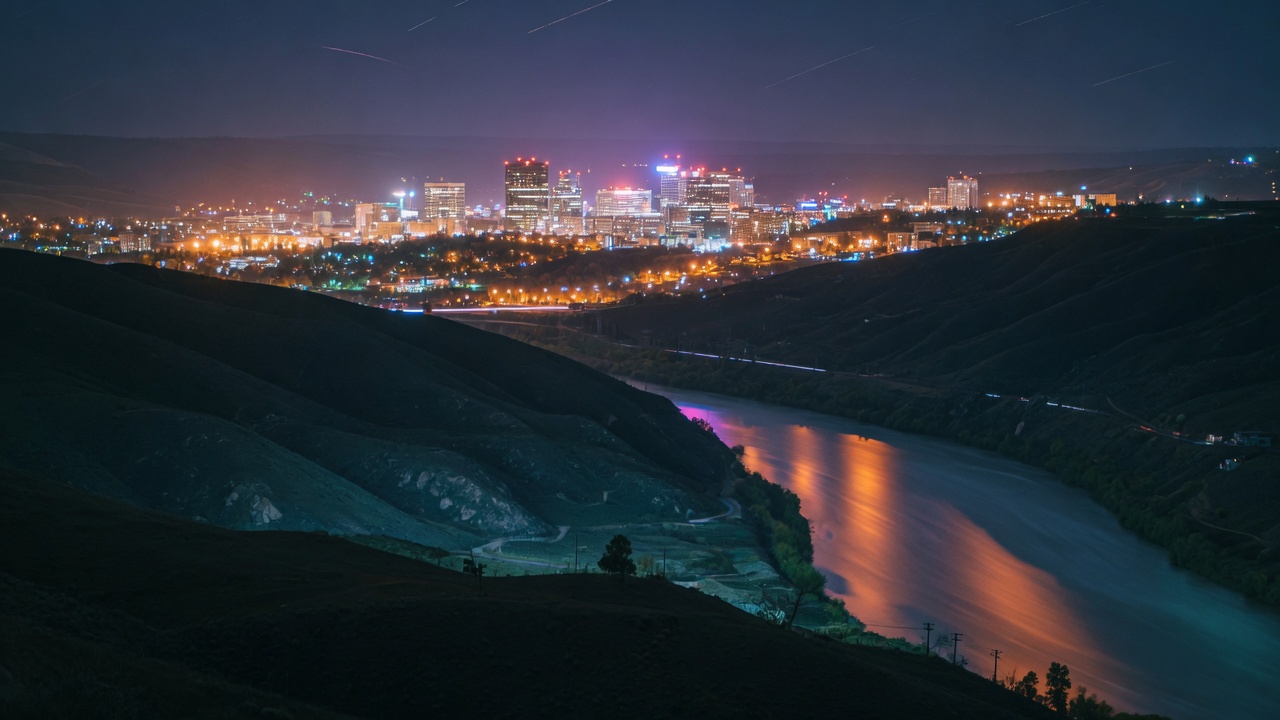
A shielded lamp still throws some light into the air. Aerosols and clouds scatter it. The result is skyglow: a dome that raises the background brightness of the night tens of kilometres from the last street. Christopher Kyba and colleagues, compiling sky-brightness measurements, found that glow varied over four orders of magnitude among sites, a range hundreds of times larger than the pre-electric night, and that overcast skies could make urban nights far brighter still, because cloud bases act as reflectors.
The 2016 world atlas of artificial night-sky brightness, by Fabio Falchi, Pierantonio Cinzano, Kyba, and others, put numbers on the civic loss. More than eighty percent of the world’s people, and more than ninety-nine percent of the populations of the United States and Europe, live under skies the atlas classifies as light-polluted. The Milky Way is hidden from more than a third of humanity, including about sixty percent of Europeans and nearly eighty percent of North Americans. About twenty-three percent of the world’s land between 75°N and 60°S, eighty-eight percent of Europe, and almost half of the United States experience polluted nights. Those figures are modelled, calibrated against measurements. They are the best global picture we have of a habitat reclassified as leftover.
Then the surface itself brightened. Using the first calibrated satellite radiometer designed for night lights—the VIIRS Day-Night Band—Kyba, Theres Kuester, Alejandro Sánchez de Miguel, and colleagues showed that from 2012 to 2016 Earth’s artificially lit outdoor area grew by about 2.2 percent per year, with total radiance up about 1.8 percent per year. Continuously lit areas brightened at about 2.2 percent per year. Only a few countries were stable or dimming. The period coincides with LEDs sold as a way to use less energy. The satellite did not record a global dimming. VIIRS is relatively insensitive to blue light, so the true increase in skyglow after a shift from sodium to white LED is probably larger than the radiance trend. The data fit a rebound: cheaper photons, more of them, in more places.
Skyglow is the part of the problem that does not require a bird to hit a window. It erases stars used for orientation, changes activity in animals that use dusk and dawn as clocks, and reaches reserves that never installed a lamp. A dark-sky designation is not nostalgia. It is the protection of a remaining unpolluted medium.
Moonlight as a timetable
On the Great Barrier Reef, a few nights after a late-spring full moon, dozens of coral species release eggs and sperm together. Peter Harrison, Russell Babcock, Bette Willis, and their colleagues documented that mass spawning in the early 1980s and published it in Science in 1984, overturning the older generalisation that most corals brooded internally fertilised larvae. Lunar and diel light cycles were identified as zeitgebers—time-givers—for the synchrony, acting with seasonal temperature. Broadcast spawning only works if neighbours release on the same night. The moon is not a romantic accessory. It is part of the reproductive machinery.
That moonlight is a cue is established. Whether coastal electric light disrupts the cue in the wild is newer work, and it should be graded as such. Paulina Kaniewska, Oren Levy, and colleagues showed that Acropora colonies kept under artificial night light, or in continuous dark, failed to spawn as colonies under natural moonlight did; gene-expression cascades were disrupted, in some treatments within days. Inbal Ayalon, Levy, and colleagues later reported delayed gametogenesis and unsynchronised release in two Indo-Pacific Acropora species under LED night lighting. In 2023, Thomas Davies and colleagues compared more than two thousand spawning observations with an atlas of underwater light pollution and found that, for the majority of genera, corals on lit reefs spawned one to three days closer to the full moon than corals on dark reefs. Association is not a completed causal proof for every reef. It is a broad signal sitting on experimental work. Probable: artificial light can shift or desynchronise spawning where it reaches the water. Unknown: how often that shift, relative to bleaching and sediment, changes reef recovery. A city on a headland can, in principle, edit the calendar of an animal that has no eyes in the ordinary sense.
A human overlap, kept in scale
This is a wildlife essay. The human circadian system is not the subject, and it is not irrelevant. Light at night suppresses melatonin. Alfred Lewy showed in 1980 that bright artificial light could drive human melatonin down to daytime levels. Later work found that ordinary room light is enough. Joshua Gooley and colleagues reported that typical indoor light before bedtime delayed melatonin onset and shortened its duration by about ninety minutes compared with dim light. Andrew Phillips, Sean Cain, and others have shown that the illuminance for fifty percent suppression averages a few tens of lux—within the range of evening homes—with large differences among individuals. Short wavelengths are disproportionately effective, because the melanopsin-containing ganglion cells that reset the clock are most sensitive there.
Established: evening electric light can suppress melatonin and shift circadian timing. Probable: chronic disruption contributes to sleep loss and, in shift workers especially, to a cluster of metabolic risks. The cancer epidemiology is more contested than the hormone measurement; this article will not turn a laboratory mechanism into a streetlight-causes-tumours headline. The overlap with wildlife is simpler. The same photons that delay a person’s night delay a bird’s. Warmer, dimmer, better-aimed light is a shared repair.
More light is not automatically more safety
The political argument against dimming is usually safety: crime, crashes, the fear of a dark street. The evidence is real and it is not a blank cheque for floodlighting.
Brandon Welsh, David Farrington, and Stephen Douglas, in a 2022 systematic review of evaluations in four countries, found that street-lighting interventions were associated with about a fourteen percent reduction in total crime in treatment areas compared with controls. The effect was clearer for property crime than for violent crime, and stronger in studies that measured both night and day than in night-only studies. If lighting worked mainly by making offenders visible after dusk, night-only studies should have shown the larger effect. They did not. One interpretation is that lighting sometimes signals investment and informal social control, not only a spotlight.
The converse experiment has also been run. Rebecca Steinbach, Phil Edwards, and colleagues examined switch-off, part-night lighting, dimming, and conversions to white light in England and Wales. They found little evidence that those adaptations increased night-time collisions or crime at the scales they could measure. The study is not a proof that any dark street is fine. It is a proof that “more lumens, less crime” is not a law.
Glare is a separate problem. An unshielded fixture that shines into a driver’s eyes can hide a pedestrian in the scene it was meant to reveal. DarkSky International (formerly the International Dark-Sky Association) and the Illuminating Engineering Society have jointly stated five principles: light should be useful, targeted, no brighter than necessary, controlled in time, and, where possible, warm in colour. Those are design rules, not a vow of darkness. You can light a crosswalk and still leave the treetops and the sky to the animals that were already using them.
A screwdriver, a spectrum, a season
Lighting is one of the rare ecological pressures that can be reduced without a new worldview. The tools are ordinary.
Shielding: a full cut-off fixture that emits no light above the horizontal. Aiming: downward, onto the task, not into a bedroom or a dune. Level: the minimum that serves the purpose; many installations exceed it because the catalogue default is generous. Control: timers, occupancy sensors, part-night dimming. Spectrum: warmer sources, and, on nesting beaches and in other sensitive sites, narrow long-wavelength lamps. Season: Lights Out during peak migration, as Audubon chapters and city programs already practise, informed now by radar forecasts of big flight nights. Towers: flashing beacons rather than steady-burning red. Glass: the other half of the bird problem, which light reduction does not solve and must not be asked to.
Kyba has pointed to cities such as Tucson, where well-designed LED retrofits have cut emissions without a public sense of gloom—if the energy savings are not spent on new light. The 2012–2016 satellite record suggests that, globally, they were.
None of this requires a sermon about cities. People need to walk home. Ports need to work. A memorial may want a beam. The question is whether the rest of the sky was vacant. It was not. Insects were already navigating. Turtles were already crawling. Birds were already aloft. Coral was already waiting for a moon.
You don’t have to sit in the dark. You can put the light where a person is walking, and stop pretending the rest of the night was empty. Darkness, in this accounting, is not the absence of a lamp. It is a public good that living things still have to use.
Sources
- Kyba, Christopher C. M., Theres Kuester, Alejandro Sánchez de Miguel, Kimberly Baugh, Andreas Jechow, Franz Hölker, Jonathan Bennie, Christopher D. Elvidge, Kevin J. Gaston, and Luis Guanter. “Artificially Lit Surface of Earth at Night Increasing in Radiance and Extent.” Science Advances 3, no. 11 (2017): e1701528.
- Kyba, Christopher C. M., et al. “Worldwide Variations in Artificial Skyglow.” Scientific Reports 5 (2015): 8409.
- Falchi, Fabio, Pierantonio Cinzano, Dan Duriscoe, Christopher C. M. Kyba, Christopher D. Elvidge, Kimberly Baugh, Boris A. Portnov, Nataliya A. Rybnikova, and Riccardo Furgoni. “The New World Atlas of Artificial Night Sky Brightness.” Science Advances 2, no. 6 (2016): e1600377.
- Longcore, Travis, and Catherine Rich. “Ecological Light Pollution.” Frontiers in Ecology and the Environment 2, no. 4 (2004): 191–198.
- Owens, Avalon C. S., Précillia Cochard, Joanna Durrant, Bridgette Farnworth, Elizabeth K. Perkin, and Brett Seymoure. “Light Pollution Is a Driver of Insect Declines.” Biological Conservation 241 (2020): 108259.
- Boyes, Douglas H., Darren M. Evans, Richard Fox, Mark S. Parsons, and Michael J. O. Pocock. “Is Light Pollution Driving Moth Population Declines? A Review of Causal Mechanisms across the Life Cycle.” Insect Conservation and Diversity 14, no. 2 (2021): 167–183.
- van Grunsven, Roy H. A., et al. “Experimental Light at Night Has a Negative Long-Term Impact on Macro-Moth Populations.” Current Biology 30, no. 12 (2020): R694–R695.
- Witherington, Blair E., and Karen A. Bjorndal. “Influences of Wavelength and Intensity on Hatchling Sea Turtle Phototaxis: Implications for Sea-Finding Behaviour.” Copeia (1991), and related experimental work on sea-finding.
- Witherington, Blair E., and R. Erik Martin. “Understanding, Assessing, and Resolving Light-Pollution Problems on Sea Turtle Nesting Beaches.” Florida Marine Research Institute Technical Report TR-2, Florida Fish and Wildlife Conservation Commission.
- Florida Fish and Wildlife Conservation Commission. “Sea Turtle Disorientations” and “Artificial Lighting and Sea Turtle Hatchling Behavior.” Agency guidance and monitoring summaries.
- Loss, Scott R., Tom Will, Sara S. Loss, and Peter P. Marra. “Bird–Building Collisions in the United States: Estimates of Annual Mortality and Species Vulnerability.” The Condor 116, no. 1 (2014): 8–23.
- Van Doren, Benjamin M., Kyle G. Horton, Adriaan M. Dokter, Holger Klinck, Susan B. Elbin, and Andrew Farnsworth. “High-Intensity Urban Light Installation Dramatically Alters Nocturnal Bird Migration.” Proceedings of the National Academy of Sciences 114, no. 42 (2017): 11175–11180.
- Van Doren, Benjamin M., et al. “Drivers of Fatal Bird Collisions in an Urban Center.” Proceedings of the National Academy of Sciences 118, no. 24 (2021): e2101666118. (McCormick Place lighting and collision record.)
- Horton, Kyle G., Cecilia Nilsson, Benjamin M. Van Doren, Frank A. La Sorte, Adriaan M. Dokter, and Andrew Farnsworth. “Bright Lights in the Big Cities: Migratory Birds’ Exposure to Artificial Light.” Frontiers in Ecology and the Environment 17, no. 4 (2019): 209–214.
- Gehring, Joelle, Paul Kerlinger, and Albert M. Manville II. “Communication Towers, Lights, and Birds: Successful Methods of Reducing the Frequency of Avian Collisions.” Ecological Applications 19, no. 2 (2009): 505–514.
- National Audubon Society. Lights Out program; collision-prevention guidance on artificial light and glass.
- Harrison, P. L., R. C. Babcock, G. D. Bull, J. K. Oliver, C. C. Wallace, and B. L. Willis. “Mass Spawning in Tropical Reef Corals.” Science 223, no. 4641 (1984): 1186–1189.
- Kaniewska, Paulina, Shahar Alon, Sarit Karako-Lampert, Ove Hoegh-Guldberg, and Oren Levy. “Signaling Cascades and the Importance of Moonlight in Coral Broadcast Mass Spawning.” eLife 4 (2015): e09991.
- Ayalon, Inbal, Yaeli Rosenberg, et al. “Coral Gametogenesis Collapse under Artificial Light Pollution.” Current Biology 31, no. 2 (2021): 413–419.e3.
- Davies, Thomas W., et al. “Global Disruption of Coral Broadcast Spawning Associated with Artificial Light at Night.” Nature Communications 14 (2023): 2511.
- Lewy, Alfred J., Thomas A. Wehr, Frederick K. Goodwin, David A. Newsome, and S. P. Markey. “Light Suppresses Melatonin Secretion in Humans.” Science 210, no. 4475 (1980): 1267–1269.
- Gooley, Joshua J., et al. “Exposure to Room Light before Bedtime Suppresses Melatonin Onset and Shortens Melatonin Duration in Humans.” Journal of Clinical Endocrinology & Metabolism 96, no. 3 (2011): E463–E472.
- Phillips, Andrew J. K., et al. “High Sensitivity and Interindividual Variability in the Response of the Human Circadian System to Evening Light.” Proceedings of the National Academy of Sciences 116, no. 24 (2019): 12019–12024.
- Welsh, Brandon C., David P. Farrington, and Stephen Douglas. “The Impact and Policy Relevance of Street Lighting for Crime Prevention: A Systematic Review Based on a Half-Century of Evaluation Research.” Criminology & Public Policy 21, no. 2 (2022): 411–440.
- Steinbach, Rebecca, et al. “The Effect of Reduced Street Lighting on Road Casualties and Crime in England and Wales: Controlled Interrupted Time Series Analysis.” Journal of Epidemiology & Community Health 69, no. 11 (2015): 1118–1124.
- DarkSky International and Illuminating Engineering Society. “Five Principles for Responsible Outdoor Lighting.” darksky.org.
The night is not empty. We just lit it as if it were.
Follow the connection
- Lamps
- Skyglow
- Disoriented migration
- Wasted energy
- Predation and decline
What we know
- Many species evolved with reliable cycles of dark and light.
- Artificial light at night can disorient migratory birds, hatchling turtles, and insects.
- Skyglow alters the night far beyond the fixture that produced it.
- Timing of feeding, breeding, and rest can shift under chronic lighting.
What remains uncertain
- How much any single city’s lighting contributes to a regional insect decline is hard to isolate from pesticides, habitat loss, and climate.
- Human safety claims for brighter streets are context-dependent; more light is not automatically more safety.
- Best spectra and shielding differ by species and by task.
What can we do?
You don't have to care about this because everyone else does. You can care because the evidence gives you a reason to.
- Shield outdoor lights so they shine down, not out and up.
- Use warmer, dimmer light where a light is actually needed.
- Turn off decorative lighting during peak bird migration when local guidance recommends it.
- Treat darkness as a public good, not only as the absence of a lamp.
Demonstration authors are fictional. The phenomena discussed are real subjects of public scientific literature and reporting. Sources named in the article are documented; this is not a comprehensive literature review.